Iliotibial Band
Understanding the Iliotibial Band (also known as Maissiat's band or IT Band)
by Deb Mann (Certified Iyengar Yoga teacher)
Anatomy (the study of the structure and relationship between body parts).
The iliotibial band is a strong, thick band of fibrous tissue that runs along the outside of the leg. The IT band starts at the hip and runs along the outer thigh and attaches on the outside edge of the shin bone (tibia) just below the knee joint. It originates at the anterolateral iliac tubercle portion of the external lip of the iliac crest and inserts at the lateral (outside) condyle of the tibia at Gerdy's tubercle.
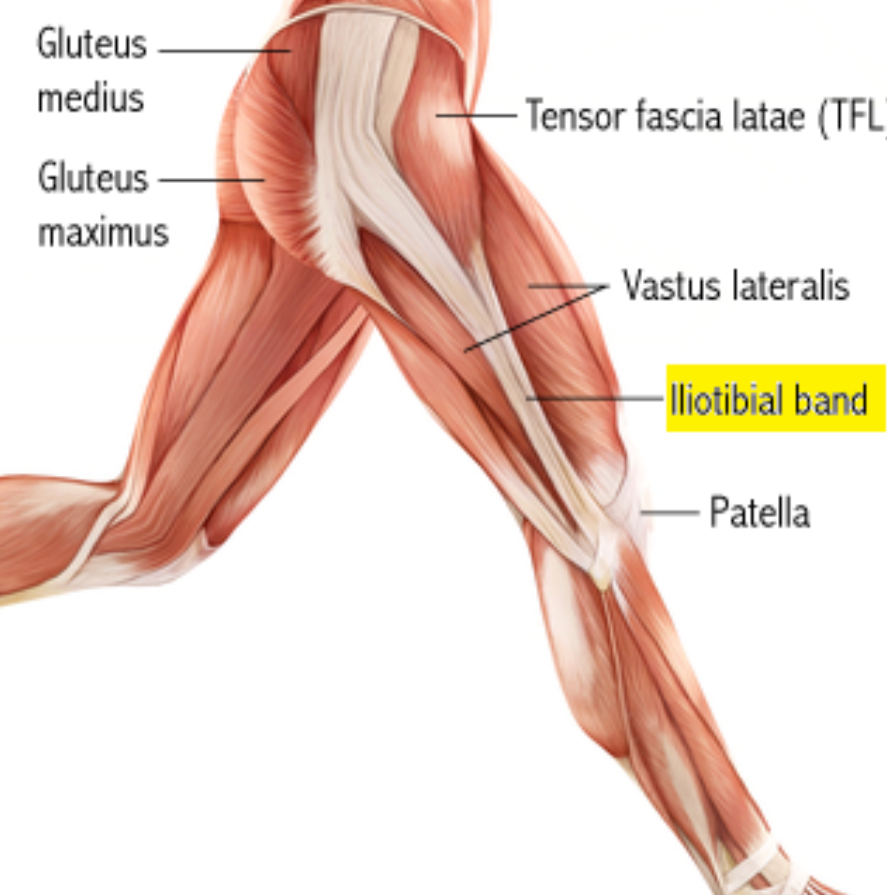
The IT band is a longitudinal fibrous reinforcement of the fascia lata. The fascia lata is the deep fascia of the thigh. Deep fascia (or investing fascia) is a fascia, a layer of dense connective tissue which can surround individual muscles, and also surround groups of muscles to separate into fascial compartments. The fascia lata encloses the thigh muscles and forms the outer limit of the fascial compartments of thigh, which are internally separated by intermuscular septa. The fascia lata is thickened at its lateral side where it forms the iliotibial tract, a structure that runs to the tibia and serves as a site of muscle attachment.[1]
The part of the IT band which lies beneath the tensor fasciae latae is prolonged upward to join the lateral part of the capsule of the hip-joint. The tensor fasciae latae effectively tightens the iliotibial band around the area of the knee. This allows for bracing of the knee especially in lifting the opposite foot.[2]
The gluteus maximus muscle and the tensor fasciae latae insert upon the tract.[3]
2. Physiology (the study of the function of body parts and the body as a whole)
The action of the IT band and its associated muscles is to extend (when the leg is taken back), abduct (move away from the midline of the body), and laterally rotate (rotate outward away from the centre line) the hip. In addition, the band works with the quadriceps (thigh muscles) to provide stability to the outside of the knee joint during movement.
During knee extension the IT band moves anterior to the lateral condyle (end) of the femur, while at 30 degrees knee flexion, the IT band moves posterior to the lateral condyle. However, it has been suggested that this is only an illusion due to the changing tension in the anterior and posterior fibres during movement.[4]
The main function of the IT band stabilizes the knee both in extension and in partial flexion, and is therefore used constantly during walking and running. When a person is leaning forwards with a slightly flexed knee, the tract is the knee's main support against gravity.
The IT band is of critical importance to asymmetrical standing (pelvic slouch). The upward pull on the lower attachment of the IT band thrusts the knee back into hyperextension, thereby locking the knee and converting the limb into a rigid supportive pillar.[5]
3. Associated Injury – IT band syndrome
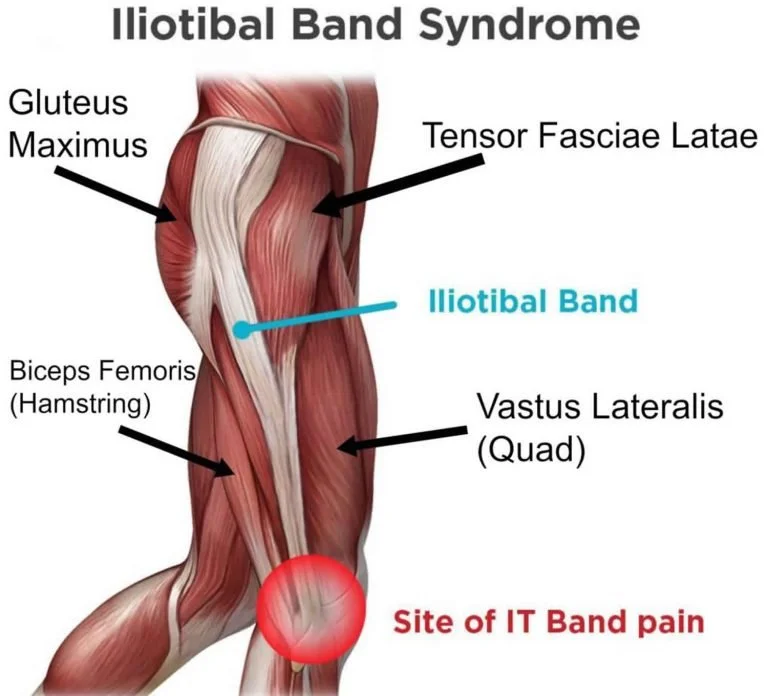
Iliotibial (IT) Band Syndrome is one of the most common causes of pain that is felt on the outside of the knee. It is most common in runners, hikers, and cyclists, but any athlete who plays sports that require repeated knee flexion can find themselves dealing with IT Band pain.
Repetitive flexing and extending of the knee (as occurs in running) may result in friction and inflammation of the IT band. The iliotibial band itself becomes inflamed in response to repeated compression on the outside of the knee or swelling of the fat pad between the bone and the tendon on the side of the knee.
The IT band acts primarily as a stabilizer during running and may become irritated from overuse. The pain is typically felt on the outside (lateral) aspect of the knee or lower thigh, but may be felt near the hip, and is often more intense when descending stairs, or getting up from a seated position.
IT band syndrome is most common in runners who perform unbalanced, repetitive exercise such as running only on one side of a crowned road, or only running one way around a track. Most roads slope off to the sides and running along the edge causes to the outside foot to be lower than the inside foot. This in turn causes the pelvis to tilt to one side and stresses the IT band.
The biomechanical abnormalities that may lead to IT band problems include: excessive pronation of the foot, leg length discrepancy, lateral pelvic tilt, and "bowed" legs. Muscle tightness or lack of flexibility in the gluteal (buttock) or quadriceps (thigh) muscles may increase the risk of IT band injuries.
IT Band syndrome can also be caused by poor physical condition, lack of warming up before exercise, or drastic changes in activity levels. Over time this irritation leads to IT Band syndrome.
Traditional treatment for IT band friction syndrome include;
R.I.C.E.: Rest, ice, compression and elevation is the best way to treat initial IT band pain.
Physical Therapy. A therapist may use ultrasound and other modalities to help the injured tissues heal more quickly. A skilled PT can also help you correct any biomechanical or training errors, and teach you how to perform the right flexibility exercises.
Reduced Activity. Runners with IT band pain should reduce running mileage and be alert for signs of overtraining syndrome.
Foam Roller Myofascial Release. Using a foam roller to release the tissues, may be painful, but many athletes have excellent success with this technique.
Anti-inflammatory medications may also be used to reduce pain and inflammation.
Rest and Recovery is an important part of your recovery and should be maintained as part of a balanced training program.
Yoga for IT band syndrome remediation and prevention
The ability to stabilize and control the knee tracking position will help take that stress off the lower IT band. For example, Utkatasana and Garudasana may be practiced keeping the width across the front of the knee to help to strengthen the inner knee. Pressing the inner heel will help to correct and prevent pronation of the foot. Ensure the pelvis is kept even to ensure the asana doesn’t cause injury. Other standing asanas which may help to strengthen and stabilise the knee are Parsvottanasana, Virabhadrasana I & III and Ardha Chandrasana and can be practiced against a wall for support.
Maintaining flexibility and stretching the IT band and external hip rotators may help prevent IT band syndrome and relieve strain. Supta Pandangusthasana I & II and Jathara Parivartanasana (with bent knee and straight legs) can be practiced.
For a more intense stretch of the external hip rotators and to encourage correct knee tracking standing and sitting twists may be done. This may bring relief to, and prevent further injury of, the IT band. For example, Parivrtta Hasta Pandangusthasana, Parivrtta Trikonasana, Parivrtta Parsvakonasana, Parivrtta Ardha Chandrasana, Marichyasana III, and Matsyendrasana I.
Strengthening and lengthening the inner thigh and inner knee may take the strain off the IT band and help correct knee tracking. For example, Vrksasana, Parsva Hasta Pandangusthasana, Ardha Chandrasana (with raised leg straight and bent), Anantasana (slow controlled lift of the leg and repetitions). Also, Utthita Hasta Pandangusthasana, and Virabhadrasana I & III. Keep widening across the front of the knees to not aggravate an inflammation/injury to the IT band where it attaches to the knee and draw the outside thigh back into its hip socket.
Or alternatively, the following sitting asanas may help to relieve strain on the outside of the knee and to the IT band attaches to the gluteus maximus - Baddha Konasana, Upavistha Konasana, Parsva Upavistha Konasana, Utthita Janu Sirsasana and Utthita Ardha Padmasana.
To help with inflammation and pain, inverted asanas may be practiced which encourage lymphatic drainage. For example, Salamba Sirsasana and Salamba Sarvangasana series, Chatushpadasana into Salamba Sarvangasana (chair), into Halasana, followed by Viparita Karani, Supta Baddha Konasana, and Savasana.
Yoga Asana Sequence for IT band
Arho Mukha Svanasana
Uttanasana
Utkatasana
Garudasana
Utthita Hasta Pandangustasana I (or to ledge to stabilise standing leg knee)
Virabhadrasana I & III (or to wall to stabilise standing leg knee)
Vrksasana
Parsva Hasta Pandangustasana
Utthita Trikonasana
Ardha Chandrasana (with raised leg straight and bent leg, against wall)
Parivrtta Trikonasana
Parivrtta Parsvakonasana
Parivrtta Ardha Chandrasana
Marichyasana III
Ardha Matsyendrasana
Upavistha Konasana
Parsva Upavistha Konasana
Utthita Janu Sirsasana
Anantasana
Supta Pandangustasana I & II
Jathara Parivartanasana (or support for feet on bolster towards the wall)
Salamba Sirsasana
Salamba Sarvangasana (chair)
Halasana (box)
Viparita Karani
Supta Baddha Konasana
Savasana
IT Band Friction Syndrome doesn't have to be a chronic, debilitating problem. A regular yoga practice incorporating the above asanas can relieve, and prevent further strain of, the IT band.
Sources:
R Khaund, M.D. and S Flynn, M.D., Iliotibial Band Syndrome: A Common Source of Knee Pain, the American Academy of Family Physicians, April 15, 2005.
Saladin. Anatomy & Physiology: 7th Edition. McGraw Hill. pg.347
Carnes, M. & Vizniak, N. (2009). Quick Reference Evidence-Based Conditions Manual: 3rd Edition. Professional Health Systems Inc., Canada, pg. 240-241.
Fairclough; Hayashi. "The functional anatomy of the iliotibial band during flexion and extension of the knee: implications for understanding iliotibial band syndrome". Journal of Anatomy. 208: 309–316.
Evans P. The postural function of the iliotibial tract. Ann R Coll Surg Engl. 1979 Jul;61(4):271-80. [PMC2492187]