ANATOMY - PHYSIOLOGY
ANATOMY - PHYSIOLOGY AND ASANA - PRANAYAMA
by A.V.Harip
70 Glorious Years of Yogacharya B.K.S. Iyengar
(Commeration Volume)
ASANAS AND PRANAYAMA
ASANAS
There are various postures we perform in our daily life like standing, bending down, lying on our back supine or lying face down prone for stop these are mere positions adopted by our body depending on the needs of the movement in our everyday life. They cannot be called asanas.
When doing an asana, the sadaka assumes a posture and adds to it vigour or effort in order to achieve a pose in which the whole body takes an active part. There is a specific purpose and a certain effect behind each asana, therefore asanas are different from the postures adopted in daily life.
There are various facts we must consider in order to understand the overall effect expected and obtained when doing asana's:
1. The type of sadhaka,
2. The asanas
3. The desired effect,
4. The effort involved.
The sadhaka: there are various types of sadhakas,
Children
a) normal health: Adults
normal health: Aged people
b) same as above, but with associated diseases and ailments.
For example: structural ailments:
-Cervical spondylosis- deformities, paresis of some groups of muscles.
-Heart and lung disorders.
-Liver and digestive system disorders.
Kidney and pelvic organs disorders.
-Lower back, loss of appetite, loss of sleep etc.
-Stiffness of the lumbar spine.
-Stiffness of various joints.
Functional ailments:
-Neuralegic pains in the limbs without any obvious, clinically positive findings.
c) Aim of the sadhaka
Some may desire a normal health, others expect to progress to higher levels of the yogasana practice, while others may simply be happy with reducing their ailment only to some extent.
2. The asanas
There are many asanas, some are easy, some difficult and not everybody can do all the various asanas. They can be classified as follows:
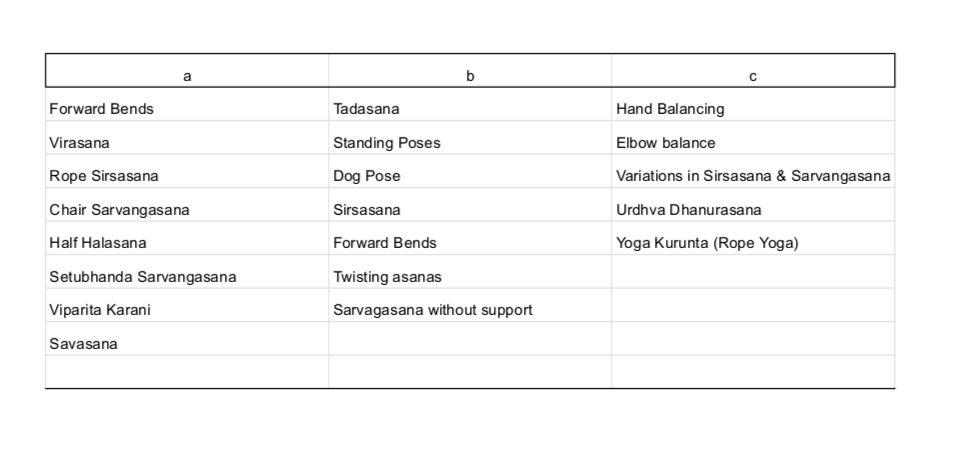
A) Asanas for the relaxation of body and mind, to recover from tiredness, weakness or exhaustion.
B) Asanas for maintaining a normal, healthy body and tranquility of the mind.
C) Asanas for improving normal health and reaching a far beyond normal level of health.
Each asana can the further divided into two groups, one group in which the asanas are assisted by different props, such as a chair, a rope, a bolster, a pillow, blankets, belt, brick etc and another group in which the same asanas are done independently without props.
Desired effect
A yoga teacher decides which asana's are to be performed by his pupils. Normally, the asanas are done in such a way that they are easier to do and will not cause any strain on the body.
Slowly, as the pupils start becoming aware of the various parts of their body and of their range of movement, the next step is the use of props. This will help them correct their poses and adjust their body to a better alignment with, for example, passive stretches and the use of different weights and ropes or ties.
It is a gradual process which has to be conducted in a systematic manner. First there are warming up asanas, such as Tadasana, Vrksasana, Trikonasana then Parsvakonasana, Parivritta Trikonasana, etc.
When more strenuous yoga asanas are performed, then we can relax the body, back to its normal level, by doing assisted Sarvangasana, half Halasana with a bandage on the eyes, Savasana etc.
As for pranayama it is the voluntary control exerted on our respiratory movements. In every asana, except in the category “a”, the respiratory system is stimulated. Inspiration and expiration become conscious acts. If the asanas are to be performed for a certain length of time, held longer, the voluntary control over inspiration and expiration is essential.
It is the experience of any sadhaka that, while doing some particular asanas, the respiratory rate as well as the heart rate increase and many times sweating occurs. After some time, the muscles and the joints involved in these asanas may even start hurting, and a certain amount of exertion is felt. However if the same asanas are performed with special attention to the respiration, there is less exertion. Inspiration causes restriction of body movements, particularly during its terminal phase, while expiration causes relaxation of the muscles which can therefore be better stretched during exhalation. With the breath awareness the body becomes more stable in any given asana, and the practitioner finds it easier and more comfortable. Controlled soft and slow inspiration and expiration can make the asana easier with less exertion involved, if any, so that one can stay in that position for a longer period of time. This continuous awareness of the breath is very useful to calm the mind, which becomes sharper, pinpointed and can excel in its performance of daily life’s activities.
NON MECHANISTIC NATURE OF THE BODY
The anatomy and physiology of the human body can be said to have adapted to one another to such an extent that the body can function in most adverse conditions. Normally a machine and it's various parts show wear and tear, which is immediately shown in the working of the machine. In the car for instance the wearing out of piston rings is immediately manifested as a lose of power, a slow response and some extra petrol consumption as well as an accumulation of carbon etc.
This does not happen in the body. When a joint starts showing signs of arthritis (wear and tear), the tissue surrounding the joint will show sympathy and adaptation. The muscles will adjust, ligaments may shorten, the blood supply increases and efforts will be made to improve the condition.
There is no such adjustment in the car. Cylinders will not shorten to adjust to a loose piston on the rings, petrol channels will not restrict the flow of petrol to avoid wastage, and so on.
In the body, there are many examples of adaptation, one kidney taking over when the other fails similarly with the lungs, the shortening of one leg being automatically adjusted while walking etc. Of course there is a limit to how much and for how long the body can do that.
HEALTHY ANATOMY AND PHYSIOLOGY
To determine how healthy one is, we need to consider the following points:
1. Posture of the individual
The posture of an individual is the correct picture of his structural health and functional condition. It tells you about the condition of the bones, joints, muscles and of the nerves supplying them. To some extent, it tells you about the blood supply to the various organs.
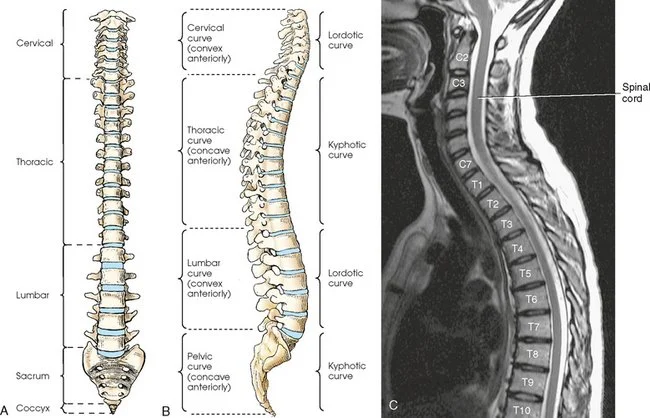
If the posture is good, then obviously, the health is good too. The spinal column is the main support of the posture, it contains many vertebra (7 cervical, 12 thoracic, 5 lumbar, 5 sacral and 4 coccygeal ones). The vertebrae are aranged in different curvatures and these are responsible for normal posture.
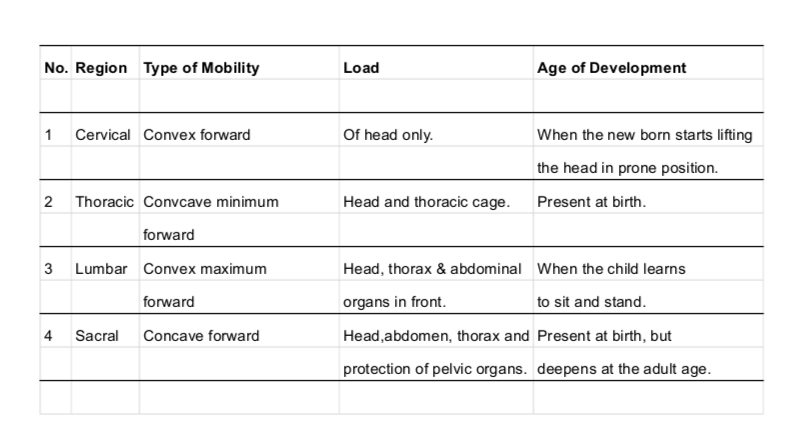
When one knows of the various curvatures and their role, one can understand how important each one is in maintaining an erect posture and health as well. Anatomically health means psychological health too, both coexist. Good mental health is equally associated with good physical health.
In yogasana we try to improve our posture by acquiring full movements of the spine. It is often the rigidity of the spine that hampers good posture. Standing poses, forward and backward bending's, all these asanas help to develop the flexibility of the spinal column. As flexibility increases, it improves the muscle stretchability and also the nerve control over it. The blood supply also increases. Normal or even greater elasticity of the ligaments is also achieved. The formation of lactic acid is minimum in yoga, isometric contraction being predominant in asana and other various related postures.
Stretching and relaxation occurring alternatively, the joints and their mobility are improved. Calcification in the joint capsules, ligaments and tendons can be broken down with yoga asanas.
The maintenance of the normal curvatures of the spine is very important when doing pranayama. In the sitting position, the spine must be erect, the shoulders are braced back and the cervical spine is fully relaxed when bending the head forward, as the chin rests on the sternum (Jalandara Bandha). This helps achieve full capacity of the lungs, which is needed in Pranayama. The muscles of respiration (intercostals, diaphragm and the shoulder girdle muscles) are free to assist respiration in any required state of Pranayama.
2. Body movements
The movements of the body in turn, depend on the posture. A healthy person will walk erect, while a weak one walks with dropping shoulders, hanging arms, caved in chest, the abdomen protruding and the legs dragging.
Adnormal anatomy such as flat feet, knocked knees etc can cause an abnormal waddling gait due to the fact that these cause an early strain on the muscles and tendons concerned. The graceful movements of a dancer highlight the basic anatomical structure and posture of the body. The suppleness and swiftness make the whole body and it's movements graceful, because of the linear control of the muscles acting on the joints through a healthy and alert nervous system.
Yogasana does exactly the same to the body by giving it normal mobility.
3. Form of the body
It is the height, weight and proportions of an individual, combined with normal posture and graceful movements that shape his or her body. It is the visual impression imparted to the observer. One can look at oneself in the mirror and understand what is being said here.
EFFECTS OF ASANA PANAYAMA ON THE ANATOMY AND PHYSIOLOGY
1. During the growth of an individual
Asanas learned in childhood and adolescence have a very good effect on the health of a child, it promotes normal growth. Growing bones respond well to the stretch stimulus. Height increases and the body becomes supple and graceful. The endurance of the child also increases. The only precaution to be taken is to avoid strenuous asanas, since in childhood, the body is fragile and susceptible to deformities is common.
1. During middle age
If asanas are started in middle-age, they will maintain normal health and prevent diseases that usually attack the body at a time of lowered resistance. The stress and strain caused by family responsibilities and financial worries can make the body weak and the mind irritable. This can be avoided with a regular practice of asanas and pranayama.
2. During old age
Asanas and pranayama maintain the micro nourishment of the decaying cells of the aging body and therefore delay the actual aging of the cells. In short, it prolongs one's life and keeps the individual fit and healthy, so that he or she can enjoy the fruits of his or her achievements. Asanas are also helpful in preventing deformities and contractures of the muscles and joints by keeping their free movements.