Dampness of Body
The Wonder of Water - The Dampness of Body
by Ting Ting Lee, certified Iyengar Yoga teacher, Aotearoa NZ.
Dampness is one of the six climatic factors taught in Chinese medicine, along with cold (寒), heat (fire⽕), wind(⾵), summer-heat(暑), and dryness(燥). Also refer to the theory of the six pathogenic factors. Due to the abnormal changes of the six climatic factors, the occurrence of excessive, such as warm and cold in spring, cold and heat in autumn etc.), beyond the human body’s adaptability, becomes a pathogenic factor. In this case, Chinese medicine is called ‘six evils’, which is an external source of disease. These factors not only influenced by the season but also the geographical environment or working environment.
Dampness is a collection of signs and symptoms. It can be apparent or hidden:
• Water weight around the middle or thighs, or edema of the ankles or face. • Swellings of any kind, including within the joints or in the sensory orifices. • Dampness is a part of arterial plaque build ups, cataracts, glaucoma, blurry vision, sinus problems, hearing loss.
• Accumulations and conglomerations. These include not only fat deposits but masses, fibroids, cysts, endometriosis, prostatitis, tumor formation, even hernias. • Signs and symptoms associated with spleen Qi deficiency: thickening of tongue coat, digestive stagnation, bloating, loose stool or alternating constipation with loose stool, cravings and appetite disturbances, brain fog, sluggishness, lethargy, difficult sleeping with difficult waking, worry with emotional impulsiveness. Dampness can progress to phlegm, sinus problems, lung congestion, and lymphatic issues.
There are many theories developed which contributes to the progression of dampness. Two aspects are of special interest:
1. Internal dampness involves some degree of dietary problem that then weakens digestion further in a self-amplifying loop.
2. Dampness is a heavy factor that tends to settle and sink from the middle jiao (middle burner) to the lower jiao (lower burner). Once in the lower jiao, stagnation blocks descension of stomach and lung qi. Heat arises to move the stagnation. If this heat (combined with the natural fire of the stomach) can’t overcome the stagnation and clear through the bowels, it rises upward, carrying dampness with it.
In modern discussion, the mention of dampness is automatically refer to the weakness of spleen Qi and was not caused directly by diet; rather it arose from stagnation due to sluggish elimination. Begin by assessing the bowels and restoring elimination in order to clear stagnation and permit the spleen-pancreas to gradually restore metabolism.
San Jiao Theory (Three burners theory)
San jiao has been translates as “triple heater”, “triple warmer”, “triple energizer” (WHO standard term) and “triple burner”.
The Upper Burner - corresponding to the thoracic cavity. This space includes lungs and heart, and is associated with respiration.
The middle burner - corresponding to the upper part of the dorsal cavity. This space includes stomach, and spleen.
The lower burner - corresponding to the lower part of the dorsal cavity. This space includes small intestine, large intestine, kidneys, bladder and is associated with elimination.
Note: other organs were not mentioned, not included in the San Jiao model.
San Jiao function
The San Jiao is also said to be a metabolism mechanism similar to an old fashioned “waterwheel” that is turned by incoming water and creates energy for accomplishing a task such as grinding grain. In the case of the Sanjiao, it is for metabolizing and digesting food. The San jiao is closely associated with the spleen functions of transformation and transportation, particularly the metabolism of incoming food. The San jiao is also closely associated with the kidney’s function in Traditional Chinese Medicine, however is not limited to one metabolism function as the spleen or kidneys are. But is a general metabolism which can be applied to a variety of metabolism need.
There are three “burning spaces” within a body model:
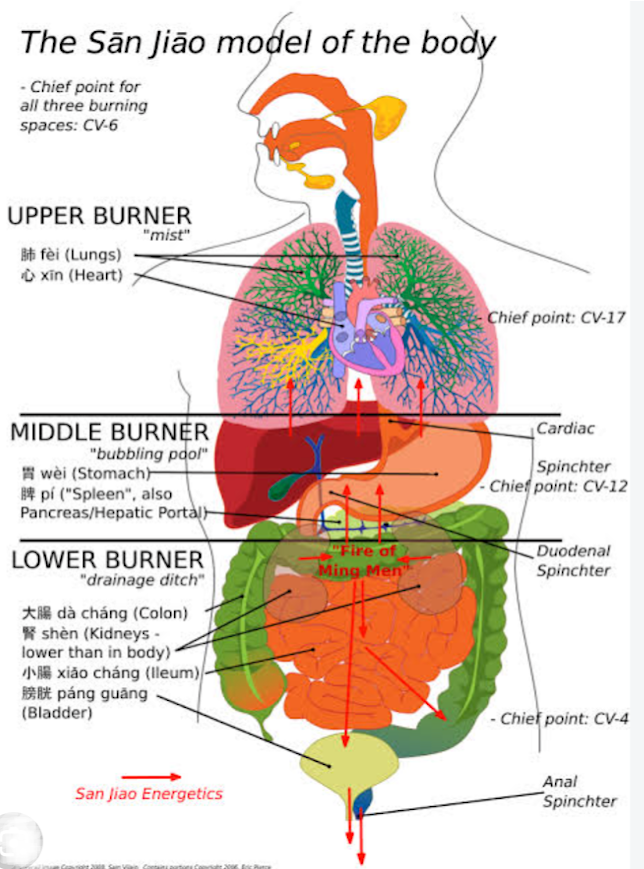
Metabolism describes all the chemical processes that go on continuously inside your body to keep you alive and your organs functioning normally. Such as breathing, repairing cells and digesting food. These chemical processes require energy.
How could yoga help?
The yoga asanas that can help the blood circulation of stomach and spleen (in TCM, the yoga asanas can help maintain the flow of Qi in stomach and spleen).
1. Reclining asanas: The asanas help relax the body and strengthen the joints for the start of the yoga. They give body the required energy for the more strenuous asanas. For example: Supta Virasana stretches abdominal muscle, aids digestion after a heavy meal, soothes acidity and stomach ulcer. This asanas also helps psoas elongation , knee joints and hip joints rotation (refer to Rachel Walsh’s Hip assignment).
2. Twists asanas: “In twists, the pelvic and abdominal organs are squeezed and flushed with blood.
They improve the suppleness of the diaphragm…, and this improves the flow of blood to the spinal nerves and increases energy (Qi) level.” (The Path to Holistic Health, BKS Iyengar, P.64)
However, this asana only refer to the loose stool affected by the body dampness not by abdominal infection.
This asanas should be avoided if you have abdominal pain infection associated with abdominal pain or dissension, vomiting, fever and chills.
Note: Standing and seated twists can help stimulating the spleen, appendix, bone marrow and other lymph nodes in the lower torso, pelvis and upper thigh. (Refer to Kylie Bailey’s Lymphatic and Immune system assignment).
3. Pranayama:
“Energy can flow only when there is attention and purity of breath.” This quote has implied the relationship of energy flow and the breath are inseparable. “The rhythmic use of the diaphragm and abdominal muscles in pranayama directly stimulates the peristaltic and segmenting movements of the intestines… as well as those containing the residue of secretions from the liver (bile), pancreas and intestines…. Also much of the splenic blood circulation is within lymphatic structures and is stimulated by pranayama.”
(Light on Pranayama, BKS Iyengar, P.56).